 heretical.com
|
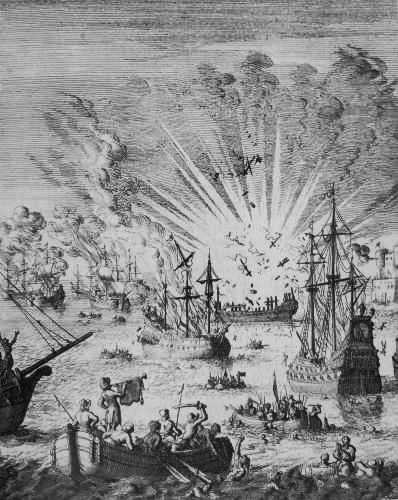
Salé’s corsairs attacked with overwhelming firepower before boarding enemy vessels. ‘With their heads shaved and armes almost naked, they did teryfie me exceedingly’ wrote one captive |
Assault on AlgiersGiles MiltonExcerpts from White Gold: The Extraordinary Story of Thomas Pellow and North Africa’s One Million European Slaves
|
Sir Sidney [Smith] and his knights drew attention to a trade that had ensnared at least one million Europeans and Americans over the previous three centuries. The largest concentration of white slaves had always been in Algiers. The city had a continuous population of about 25,000 captives between the years 1550 and 1730, and there were occasions when the number had almost doubled. During the same period, some 7,500 men, women and children had been held in Tunis and Tripoli. The number of slaves in Moulay Ismail’s imperial capital was more difficult to ascertain, even though the conditions in which they were held were better documented than elsewhere in North Africa. The 5,000 captives reported by European padres were contested by Ahmed ez-Zayyani, who claimed that the real figure was at least five times higher.
Although North Africa’s slave population had fallen to 3,000 by the time of the Congress of Vienna, Sir Sidney knew that this was a recent development. He was also aware that snapshot statistics told only part of the story. The number of slaves shipped to North Africa each year was always dependent on the rate at which they died, apostatised or gained their freedom. Dysentery, the plague and forced labour killed thousands, requiring the corsairs to put to sea in search of replacement captives. The ransoming of slaves also played its part in sustaining the flow. For two centuries, perhaps three, there had been an influx to Barbary of almost 5,000 white slaves each year. (pp. 271-272)
[The American] government had taken bullish action against North Africa. It had sent a fleet to Algiers just a few months earlier and successfully forced the authorities to release all their American slaves. With this mission uppermost in their minds, the southern European rulers began taunting Britain’s foreign secretary, Lord Castlereagh, for this lack of enthusiasm for an attack on Barbary. They accused him of deliberately turning a blind eye to the ravages of the corsairs, since Britain stood to benefit whenever her trading rivals were attacked.
Lord Castlereagh was stung by these criticisms. He had been forceful advocating the abolition of the black slave trade; now, he vowed to end the trade in white slaves as well. In the summer of 1816, he persuaded the British government to despatch a large fleet to the Mediterranean. Its goal was to compel the rulers of Barbary to stop seizing and selling European captives. There was to be no debate, no payment of bribes and absolutely no concession. ‘If force must be resorted to,’ read the British government’s lofty statement of intent, ‘we have the consolation of knowing that we fight in the sacred cause of humanity.’
There was never any doubt as to who would command this great squadron. In public life he was known as Lord Exmouth [aka Sir Edward Pellew], the Vice Admiral of the Mediterranean fleet. (pp. 272-273)
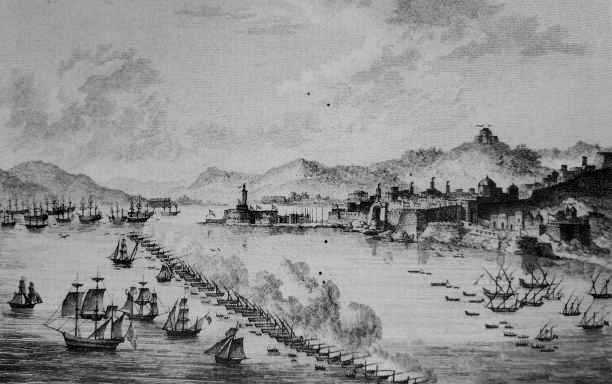
His [Pellew’s] formidable fleet arrived off Algiers at the end of August 1816. He anchored his flagship, the Queen Charlotte, in the bay of Algiers and sent an uncompromising message to the ruling dey, Omar Bashaw. Omar was given one hour to capitulate unconditionally, release his slaves and renounce for ever the trade in captured Europeans. When the dey failed to answer, Pellew declared war.
His fleet made a most impressive sight as it manoeuvred into battle positions. He had eighteen men-of-war – some armed with more than 100 big guns – and his forces were bolstered by a squadron of six Dutch vessels. But his optimism about the battle ahead was tempered by the knowledge that Omar Bashaw was a shrewd military tactician, who had strengthened the city defences in anticipation of attack and had called upon the services of thousands of war-hardened fighters.
Each commander was aware that he was playing for the very highest stakes. If Pellew won the battle, the white slave trade would finally be brought to an end. But if he lost, the prestige of the Barbary corsairs would be hugely enhanced. The 3,000 slaves still being held in North Africa would be condemned to perpetual captivity, and European merchant vessels would once again be in danger of attack.
The battle began with a single shot fired from a land battery close to the shoreline. Whether or not it was fired accidentally will never be known, but it wrung a terrible response from the furious Pellew. He had already informed his various captains of the signal for action. Now, standing proudly on the deck of his flagship, he raised his hat high above his head, held it still for a moment, then swung it down towards the deck. As he did so, there was a thunderous roar as all the ships of his fleet opened fire. His own ship, the Queen Charlotte, heeled to port as her twenty-four-pounders blasted their first broadside at the city defences. In the maintop and foretop, the twelve-pounders also let rip, each gun unleashing 300 musket balls at the defending corsairs. As the townspeople of Algiers dived for cover, the other ships of Pellew’s fleet discharged broadside after broadside, sending hundreds of cannon-balls crashing into forts, batteries and armed houses. The American consul, William Shaler, left a graphic account of the destruction wrought by Pellew’s big guns. ‘The cannonade endures with a fury which can only be comprehended from practical experience,’ he wrote. ‘Shells and rockets fly over and by my house like hail.’
The dey’s forces put up a stiff resistance, firing an increasing number of cannonades at Pellew’s fleet. The commander of the Impregnable reported that he had lost 150 killed or wounded, while the Glasgow was hit by dozens of rounds. Even more alarming was the accuracy of Omar’s snipers and sharpshooters. A group of them were hiding in the mole-head battery, from where they were able to pick out the finely uniformed officers on the decks of the British ships. Several had their sights on Pellew, aware that his death would be a devastating blow to the attacking forces. Two muskets shots passed clean through Pellew’s clothing but – miraculously – left him uninjured. A third smashed the telescope he was clutching under his left arm. As the heat of battle intensified, a large splinter of wood was embedded in his jaw and a spent shot struck his leg.
Omar’s forces grew increasingly confident as the day wore on. They were wreaking havoc on Pellew’s fleet, shattering timbers with their heavy shot and disabling rigging and sails. ‘Legs, arms, blood, brains and mangled bodies were strewn about in all directions,’ wrote Lieutenant John Whinyates. ‘You could scarcely keep your feet from the slipperiness of the decks, we with blood.’ Yet Pellew refused to withdraw to safety, for he believed it was his sacred duty to fight to the death. ‘The battle was fairly at issue between a handful of Britons in the noble cause of Christianity,’ he wrote, ‘and a horde of fanatics.’
As dusk descended over Algiers, the tide of battle slowly began to turn. By ten o’clock, the British forces had rained down more than 50,000 cannon-balls on Algiers, reducing the main town batteries to rubble. Pellew could now turn his attention to the great corsair fleet in the harbour. He unleashed firebombs and shells into the tightly packed vessels, with devastating effect. ‘All the ships in the port... were in flames,’ he wrote, ‘which extended rapidly over the whole arsenal, storehouses and gunboats, exhibiting a spectacle of awful grandeur and interest no pen can describe.’ By one o’clock in the morning, everything in the marina was on fire, and the fireball was rapidly fanning out towards the city.
When dawn broke the next morning, Consul Shaller rubbed his eyes in disbelief when he saw the extent of the destruction. Much of the city lay in ruins, including his own consulate, and entire quarters of Algiers had ceased to exist. ‘The city has suffered incredibly,’ he wrote. ‘There is hardly a house without some damage, and many are ruined.’ The harbour presented an even more awesome sight. ‘The bay was full of the hulks of their navy,’ wrote Pellew’s interpreter, Abraham Salamé, ‘smoking in every direction.’ He added that ‘the most shocking and dreadful sight was the number of dead bodies which were floating on the water.’ More than 2,000 Algerines had been killed – many of them corsairs – and an even greater number were fatally injured. The British, by contrast, had suffered 141 dead and 74 wounded.
Pellew was anxious to restart hostilities at first light, but he soon found that there was no need for further action. The dey of Algiers made a brief survey of his once-glorious capital and realised that he could no longer continue the fight. He surrendered unconditionally – a humiliating blow to his pride – and agreed to all of the British commander’s demands. These included the release of all the remaining slaves in Algiers, and the abolition – for ever – of Christian slavery.
The 1,642 slaves being held in Algiers could scarcely believe that their ordeal was finally at an end. During the battle they had been chained together and moved to an underground cavern on the hillside above the city. When they learned of Pellew’s victory – and discovered that their guards had fled – they tore free from their shackles and burst out of their temporary prison. ‘We rushed out of the cave,’ wrote the French slave, Pierre-Joseph Dumont, ‘and dragging our chains, pushed forward through brambles and thickets, regardless of the blood streaming from our faces and bodies. We simply did not feel our wounds any longer.’
Abraham Salamé was shocked at the condition of the newly liberated slaves. ‘When I arrived on shore, it was the most pitiful sight to see all those poor creatures, in what a horrible state they were.’ But for the slaves themselves, this was the moment they had dreamed of for many years. They cheered, they sang with joy and then – with one exultant cry – they shouted, ‘Long live the English admiral.’ (pp. 274-277)
White Gold: The Extraordinary Story of Thomas Pellow and North Africa’s One Million European Slaves, Hodder & Stoughton, London, 2004.
