 heretical.com
|
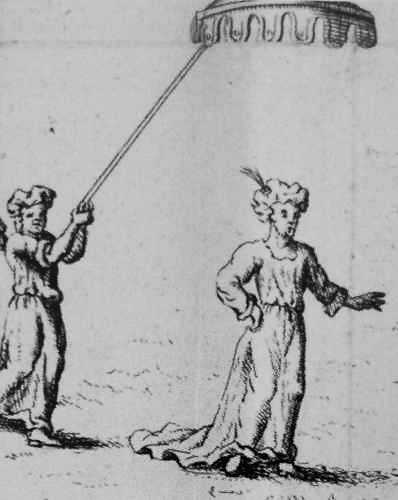
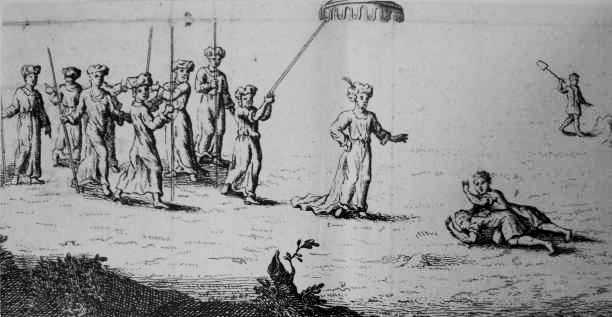
Sultan Moulay Ismail demanded absolute deference from both subjects and slaves. Anyone granted an audience had to fling himself into the dust at the sultan’s approach |
Armoury and StablesGiles MiltonExcerpts from White Gold: The Extraordinary Story of Thomas Pellow and North Africa’s One Million European Slaves
|
He [Thomas Pellow] and the other six were also placed under the command of a black guard. They were then marched across the courtyard and escorted to a large door that opened on to an underground passage. This, in turn, led into a storehouse called the Koubbat el-Khayyatin, a subterranean labyrinth ‘where the tailors work and the armoury is kept.’ Built on an impressive scale, it contained enough military hardware to equip the sultan’s 150,000-strong standing army. A later English visitor described it as being ‘near a quarter of a mile long’ and filled with ‘great quantities of arms in cases.’
Thomas Pellow and the others were ‘directly employed in cleaning the arms.’ Moulay Ismail was immensely proud of his arsenal, much of which had been pillaged from captured Christian vessels, and demanded that every pike and musket be kept in immaculate condition. From down till dusk, Pellow and his comrades worked alongside hundreds of other European slaves employed in repairing weaponry and cleaning gunlocks. The work was carried out in near-darkness, for the only light came from tiny holes that perforated the great vaulted ceiling.
Pellow was not kept in the armoury for long. Just a short time after he had been sent there, a guard arrived and ordered him to lay down his tools. ‘I was taken out of the armoury,’ he later wrote, ‘and was given by the emperor to Moulay Spha, one of his favourite sons.’
This was the worst possible news. Moulay es-Sfa was a most unsavoury individual who displayed a sneering contempt towards his European slaves. It is not clear as to why he selected young Pellow to join his household, for he had no need for any more slaves. Pellow was given futile tasks to perform, ‘run[ning] from morning to night after his horse’s heels.’ (p. 79)
There are few records from Meknes between the years 1717 and 1720. The surviving British slaves had begun to lose hope of ever being released from their misery. A lone anonymous letter, which appears to have been written in the spring of 1717, suggests that conditions were as appalling as ever.
‘Ye rains are now pretty well gone,’ it reads, ‘so that it’s now beginning to be hot and long days.’ The writer added that it was enough ‘to pierce a man to think of standing, sixteen hours or more, bare-headed in the sultry hot sun’ and noted that forty-one of the British captives had recently died from hunger, sickness or the gruelling daily regime. The men were still working on the outer reaches of the imperial palace and were forced into ‘carrying prodigious loads of dirt and stones from morn to night, without intermission, on our bare heads, without any difference twixt masters and men.’ The same correspondent said that ‘we are all alike miserable, and I run the risk of many bastinadoes for the present stolen moments.’
The men were probably working on the Dar al-Mansur, a monumental edifice that stood on the edge of the palace compound. Some of the slaves may also have been toiling on the enlarged stables, whose size and scale had already impressed Father Busnot when he visited them a few years earlier. The interior walls were almost a mile long and supported row upon row of arched galleries. Each arch was supplied with fresh running water, and there were fountains, pavilions and exquisite domed storehouses for the horses’ bridles and saddles. Father Busnot thought that the stables were ‘the beautifullest part of his palace.’ By about 1719, they had become one of the largest.
Accounts vary as to how many horses were housed in them at any given time. Some visitors counted 1,000; others claimed to have seen more than 10,000 in the enlarged outhouses. The Moroccan chronicler, Ahmed ben al-Nasari, said the total number of horses was closer to 12,000.
Moulay Ismail was obsessed with the care of these horses and selected his most trusted slaves to pamper them. He decreed that every ten stallions should have two captives to care for them and provide them with every possible luxury. The sultan’s favourite horses were fed with lightly perfumed couscous and camels’ milk. Others were given sweet herbs that were gathered by the slaves each morning. Horses that made the pilgrimage to Mecca were given right royal treatment: they were exempt from labour, and the sultan himself declined to mount them. The slaves who cared for these sanctified animals were under the strictest orders and were punished with great severity if they slacked in their duty. Every time the horse urinated, they had to be ready with a vessel in order that the holy urine did not have contact with the earth. Some years earlier, the French ambassador, Pidou de St Olon, watched in bemused disbelief as he was shown a horse that had recently returned from Mecca. ‘It was led in state just before him [Moulay Ismail],’ he wrote. ‘His tail was held up by a Christian slave, who carried a pot and a cloth to receive his excrements and wipe him. I was told that the king, from time to time, went to kiss that horse’s tail and feet.’
A group of specially selected slaves was also charged with caring for the sultan’s extensive menagerie. Many of these animals had been presented to him as gifts from various African rulers and included wolves, leopards, lions and lynxes. He was particularly attached to two of his camels, which were ‘as white as snow,’ and instructed his slaves to wash them with soap every other day.
Moulay Ismail also had an obsession with cats and had forty of them as pets, ‘all of the distinguished by their names.’ He always visited them when they were being fed by the slaves and was accustomed to throw them ‘whole quarters of mutton.’ On one occasion, the sultan was horrified to discover that one his favourite cats had snatched a rabbit from its warren and killed it. Instead of punishing the slave in charge, as everyone expected, the sultan ordered ‘that an executioner should take that cat, that he should drag it along the streets of Meknes with a rope about its neck, scourging of it severely and crying with a loud voice: “Thus my master used knavish cats.”’ Once this gruesome spectacle had been performed, the unfortunate feline had its head chopped off. (pp. 131-133)
White Gold: The Extraordinary Story of Thomas Pellow and North Africa’s One Million European Slaves, Hodder & Stoughton, London, 2004.
