 heretical.com
|
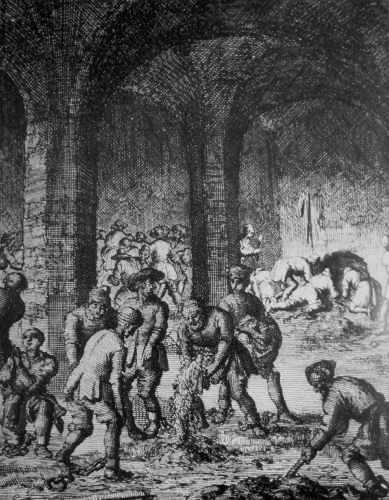
Slaves were housed in matamores, or underground dungeons, that were ‘filthy, stinking and full of full of vermin.’ Captives wore chains around one ankle |
Slave-BreedingGiles MiltonExcerpts from White Gold: The Extraordinary Story of Thomas Pellow and North Africa’s One Million European Slaves
|
Moulay Ismail was dependent on his renegades to quash rebellions, yet he never trusted them in the way he did his infamous bukhari or black guard. This formidable fighting force provided the back bone to Moulay Ismail’s rule; from its ranks came his personal bodyguards, his crack troops and his slave-drivers. The black guard was fiercely loyal and highly trained, and the troops never wavered in their devotion to their master. They originated from Guinea, where most had been seized in battle or bought as slaves in exchange for ‘salt, iron-ware, little looking glasses and other peddling toys that came from Venice.’ They were led in chains to Meknes, where they were trained to act with the blind loyalty that had once been the hallmark of the Turkish janissaries. Their name, bukhari, came from their oath of allegiance to Moulay Ismail, which they swore upon a copy of the Sahih of al-Bukhari, a ninth-century theologian.
Those who formed the sultan’s personal bodyguard were very young – between twelve and fifteen years of age – and their mothers were generally housed in the harem. ‘He chuses ‘em such,’ wrote Pidou de St Olon, ‘because he will not trust the guard of his person to those of a proper age, for fear of some attempt against him.’ Extremely haughty in their manner, these brutal young guards were dressed in the most costly clothes – finely cut kaftans in purples, indigo and scarlet – and wore exquisite silk stockings, making a splendid sight as they strutted and drilled in the parade grounds of the imperial palace. They wore scimitars by their sides and carried heavy muskets, which, according to one English slave, ‘they must keep, upon pain of death, as bright as when it first came out of the gunsmiths’ hands.’ Unlike most of the sultan’s subjects, they were never allowed headgear. ‘Their heads were shaved and always exposed to the sun,’ wrote Pellow, ‘for he affected to breed them hard.’
Pellow witnessed these bodyguards in action and was stunned by their ruthless efficiency. ‘They were so ready to murder and destroy,’ he wrote, ‘... that the kaids trembled at the very sight of them.’ Always carrying out the sultan’s orders to the letter, they took especial pleasure in dealing with those sentenced to be executed. If the condemned man was not to be killed immediately, they battered and beat him until he squealed for mercy. Pellow witnessed their treatment of one victim, who was almost torn to pieces by the time he reached the place of execution. ‘By the fury of their looks, and their violent and savage manner ... [they] made a scene very much resembling the picture of so many devils tormenting the damned.’
As well as providing Moulay Ismail with his personal bodyguard, the bukhari patrolled Meknes and helped to supervise the sultan’s Christian slaves. ‘They were strict taskmasters, accustomed to whip and flog the captives under their charge. Francis Brooks was one of the British slaves who frequently felt the lash of these guards. ‘The poor Christians were grievously hurried and punished by these hellish rogues,’ he wrote. ‘[They] had scarce time to take any nourishment or eat any of their bad bread ... but with a great many threats, stripes and blows by the negroes, bidding them to turn Moors.’ The bukhari also helped to enforce the sultan’s rule in the rebellious mountain areas. There were said to be 150,000 black troops stationed in various parts of Morocco – 25,000 in Meknes and a further 75,000 in the garrison town of Mahalla, south-east of Salé. The rest were posted to kasbahs on the frontiers of the country.
Their number was constantly replenished by the great breeding farms and nurseries that Moulay Ismail had established outside Meknes. He visited these nurseries each year and would take back all the ten-year-olds to Meknes. The girls were taught cooking, washing and housekeeping in the imperial household, while the boys were prepared for military training. (pp. 147-149)
Moulay Ismail’s behaviour was always unpredictable and he had been known to call for impromptu inspections of his household retinue. On one occasion, Pellow noticed that the sultan was ‘on the merry pin’ and anxious to be amused. With a malicious smile, he ordered 800 of his servant-slaves – including Pellow – to be brought before him. When they were assembled in the palace parade ground, he called for an equal number of women to be summoned from the palace. He then gave a brief address, informing the men that he had, ‘on several occasions, observed their readiness and dexterity in obeying him.’ As a reward for their loyal behaviour, he said, he had decided to present each one of them with a wife. The men assumed he was joking, but Moulay Ismail was in earnest. He entered the throng with great enthusiasm and began matching men and women, ‘some by his own hand... and to others by the beckoning of his head and the cast of his eye, where they should fix.’
Pellow was horrified by the spectacle that followed, particularly when he realised that he was not immune from the sultan’s matchmaking. ‘I was also called forth and bid to look at eight black women standing there, and to take one for a wife.’ Pellow looked them up and down, but found none to his taste. It was not their looks that he disliked. Pellow, filled with the prejudices of his age, objected to the colour of their skin. The women had been brought as slaves from tropical Africa and were all jet black.
‘Not at all liking their colour,’ wrote Pellow, [I] immediately, bowing twice, falling to the ground and kissing it, and after that the emperor’s foot... humbly entreated him, if, in case I must have a wife, that he would be graciously pleased to give me one of my own colour.’
Pellow was taking a great risk in making such a request. Yet Moulay Ismail was bemused by his entreaty and ordered seven half-caste slaves to be summoned from the palace. None of these pleased Pellow, ‘at which, I again bowed to the ground, still entreating him to give me one of my own colour.’ The sultan was all too familiar with Pellow’s obstinacy, and his good humour prevailed. ‘[He] sent for a single woman, full dressed, and who, in a very little time appeared with two young blades attending her.’ When Pellow was ordered to take her hand, he got a shock. ‘I perceived it to be black also, as soon after I did her feet.’ The effect was just as the sultan intended. He ‘ordered me to lift up her veil... and look at her face.’
Doing as he was commanded, Pellow was surprised to discover that the girl was much paler than most, and that her hands and feet had been stained with henna. ‘[I] found her to be of a very agreeable complexion,’ he wrote, much to Moulay Ismail’s delight. ‘The old rascal [was] crying out, in a very pleasing way, in the Spanish language, “Bono! Bono!” Which signifies “Good! Good!”’ He decreed that Pellow and the girl should be married without further ado.
The sultan enjoyed marrying off his slaves and counted it as one of his chief pleasures. He often placed himself in the role of chief officiator, standing in front of the crowd and pointing to a male and female slave. According to Pellow, he would call out ‘that take that,’ and the couple would march off ‘as firmly noosed as if they had been married by the Pope.’ Moulay Ismail paid particular attention to the skin colour of the children they would produce. He was particularly fond of mulattos, or half-castes, and ‘always yokes his best complexioned subjects to a black helpmate, and the fair lady must take up with a negro.’
Moulay Ismail had hit upon the idea of breeding slaves early on in his reign. He found mulattos to be the most trustworthy of his servant-slaves and often forced his white slaves to wed black women in order to replenish his household of loyal half-castes. ‘He took care to lay the foundation of his tawny nurseries,’ wrote Pellow, ‘to supply his palace as he wanted.’ Pellow said that the offspring from these enforced unions were reared by Moulay Ismail’s own officers, and ‘taught to worship and obey that successor of their Prophet, and being nursed in blood from their infancy, become the executioners and ministers of their wrath.’
Such bizarre breeding programmes were by no means unique to Morocco. Mixed-blood slaves were also reared in Algiers, in order to increase the stock of half-caste servants of the regime. The French captive, Chastelet des Boyes, was bought by a slave master who kept fifteen or sixteen black women on his farm close to Algiers. He would regularly send his white slaves to breed with them and on one occasion selected Chastelet des Boyes. The Frenchman was taken to the farm by a eunuch, who ordered four of the women to strip him and set to work. ‘Having spoken to them,’ wrote de Boyes, ‘he shut the door behind us, leaving me food... [and] a bottle of date brandy.’ The eunuch remained close by and kept a watch on the sexual activity occurring within. ‘He didn’t fail,’ wrote de Boyes,’ ... evening and morning, to give us serenades on his drum.’ After six days of sexual activity, the eunuch entered the room and released de Boyes. ‘He had a private talk with each one of the black women, and took me back to the patroon [slave owner] in the town.’ (pp. 127-129)
White Gold: The Extraordinary Story of Thomas Pellow and North Africa’s One Million European Slaves, Hodder & Stoughton, London, 2004.
