 heretical.com
|
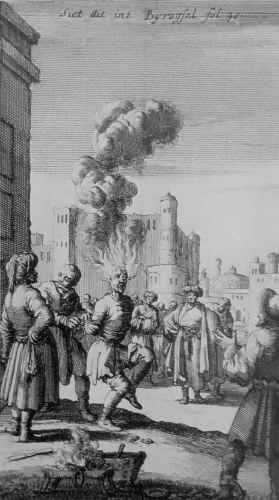
Torture of slaves was commonplace |
Reigns of MonarchsGiles MiltonExcerpts from White Gold: The Extraordinary Story of Thomas Pellow and North Africa’s One Million European Slaves
|
The abandonment of Tangier did not change Moulay Ismail’s attitude towards the English, nor did it encourage him to release any of his slaves. King Charles II died in 1685. During the short reign of King James II, many hundreds of English captives languished in their underground cells, alongside thousands of French, Spanish, Portuguese, Dutch and Italians. No attempt was made to win their freedom and the first news of them for many a year was received in 1689, when a Dutchman, Jan Smit Heppendorp, managed to visit a cell containing 400 English and North American captives. He wrote to William of Orange, England’s Dutch-born monarch, informing him they were ‘in great misery and servitude, such as there is no resemblance of in any other part of the world.’
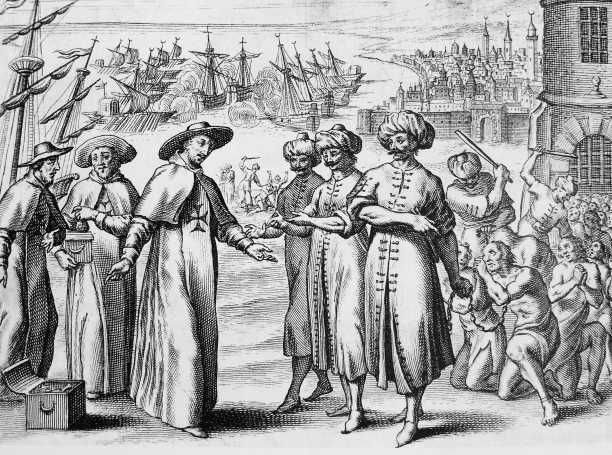
King William III’s conscience was pricked by this news and he began a series of discussions about their liberation. For five long years he attempted to haggle and negotiate, but the sultan kept demanding an increasingly large ransom. King William was so anxious to free the slaves that he eventually agreed to the extortionate sum of £15,000 and 1,200 barrels of gunpowder, sending Captain George Delaval to Morocco with both. ‘The ship was so full of pouder,’ wrote Delaval, ‘that we were in continuall fear of her blowing up.’
Moulay Ismail began disputing the terms of the agreement within hours of the English captain landing in Tetouan. Delaval was exasperated but displayed commendable spirit in refusing to hand over the money until he had tangible evidence that the slaves were going to be released. His persistence – and presents – eventually bore fruit. In December 1701 the sultan agreed to free 194 of his English slaves, leaving just 30 in Meknes.
These last few captives were still being held by the sultan when Queen Anne came to the throne in 1702 and they looked set to spend the rest of their lives as slaves. But when the queen hinted that she might be interested in joining Moulay Ismail in an Anglo-Moroccan attack on the Spanish enclave of Ceuta, they were suddenly – and unexpectedly – released.
Their arrival in London was greeted with an outburst of public rejoicing, for it seemed as if the menace of the Salé corsairs had lifted at long last. The queen’s ministers, too, breathed a collective sigh of relief. For the first time in 150 years, not a single English slave was being held on Moroccan soil. But Moulay Ismail had no intention of forging a lasting peace with Queen Anne. When the queen eventually declined to provide troops for the sultan’s offensive against Ceuta, he told his Salé corsairs that British vessels were once again legitimate targets. After a truce that had lasted just three years, several trading vessels were seized and the fifty-five mariners on board found themselves incarcerated in Meknes. ‘Pray God incline you to pity us,’ wrote James Hill, one of the slaves. ‘[We are] naked and abused, in prisons, without close [clothes] or any other necessaries.’
Moulay Ismail’s formula of capture, ransom and occasional release was to set the pattern for the rest of Queen Anne’s reign. He only ever redeemed slaves if he thought he stood to profit and always used his captives as instruments of his foreign policy. (pp. 49-50)
Moulay Ismail proved extremely adept at controlling the European renegades, the black guard and the wealthiest Jews. Any one of these groups could have threatened his rule, yet they were always denied the opportunity to challenge his excesses. Those suspected of plotting against the sultan were instantly despatched with the blow of a cudgel or the slice of a sword. ‘His government is more than despotick,’ wrote Father Busnot. ‘He treats all that belong to his empire not as free subjects but as slaves.’ The padre added that Moulay Ismail saw himself as the very embodiment of the law, who killed in order to demonstrate his ruthlessness. ‘He strikes off heads only to show his dexterity, without any remorse; or obliges his subjects to cast themselves down precipices headlong to exert his absolute authority.’
Visitors to the court were surprised by the extent to which Moulay Ismail retained his grip on power. He rarely displayed any concerns about being overthrown, even when there was a real danger of widespread rebellion. Father Busnot’s visit to the court coincided with a period of great turmoil, when a number of powerful warlords were threatening to overthrow the sultan. Yet Moulay Ismail appeared to have not a care in the world, ‘giving audience to strangers; indulging himself in the pleasure of the seraglio [and] spending the rest of his time in forwarding his slaves’ work.’ The padre was convinced that he was about to witness the destruction of Moulay Ismail, unaware that the sultan’s extensive network of informers were monitoring every aspect of the rebellion. ‘All was looked to be lost,’ he wrote, ‘when, by the means of some secret springs working without arms, without councils, without any visible efforts, all those storms were laid, the mutineers crushed, the ringleaders delivered up to him, and put to the most dreadful punishments his revenge could invent.’ (pp. 153-154)
Moulay Ismail had fallen sick several months earlier, and his closest courtiers quickly realised that he would not recover. He demanded this physicians work harder to find a cure and grew increasingly frustrated when their elixirs and potions failed to restore him. ‘His distemper towards his latter end became so nauseous that no-one could bear the room where he lay, notwithstanding all the art of perfumes.’ So wrote John Braithwaite, who accompanied Consul Russell on his mission to Morocco. Moulay Ismail remained as virile as ever, despite his bodily decay, and summoned his wives and concubines to his bedside in order to relieve his suffering. ‘For his recovery,’ wrote the Frenchman Adrian de Manault, ‘he demanded such disgusting acts that decency won’t allow us to relate them.’
His end, when it came, was quite sudden. His ancient frame was already racked with disease when he contracted a ‘mortification in the lower part of his belly.’ This prevented him from moving, and the chief eunuch perceived that the end was imminent. On 22 March, ‘at the hour the muezzin calls the faithful to midday prayer,’ the great Moulay Ismail finally expired. He was eighty years of age and had ruled Morocco for a remarkable fifty-five years.None of the sultan’s courtiers recorded his final mutterings, and it is impossible to know if he went to his death with a clear conscience. In the course of his reign, he had overseen the deaths of thousands of men and women, a number of whom had been butchered by his own hand. He had ordered countless courtiers to be dragged behind mules until they were dead and had slain dozens of his imperial guard. Several of his sons had been put to death, and he had maimed and mutilated many of his wives. At least two of his subjects had been sawn in two, and numerous kaids and officers had lost eyes and limbs. But Moulay Ismail had reserved his greatest contempt for his slaves, who had been butchered and tortured, mutilated and broken. (pp. 223-224)
White Gold: The Extraordinary Story of Thomas Pellow and North Africa’s One Million European Slaves, Hodder & Stoughton, London, 2004.
