 heretical.com
|
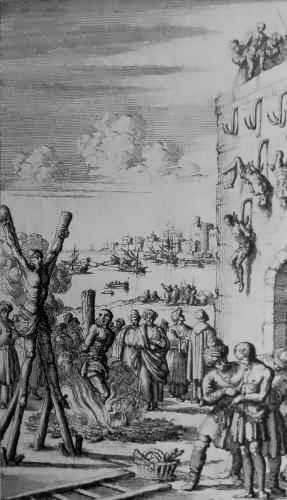
Torture of white slaves was routine |
Treatment of SlavesGiles MiltonExcerpts from White Gold: The Extraordinary Story of Thomas Pellow and North Africa’s One Million European Slaves
|
The black guards kept a meticulous note of the slaves under their charge and were careful to record any mortality. These daily tallies have long since been lost, and the surviving records are frustratingly incomplete. The accounts of visiting ambassadors, padres and the captives themselves suggest that at any given time there were up to 5,000 slaves being held in Meknes. But the Arabic sources tell a more troubling story. The nineteenth-century Moroccan historian, Ahmed ez-Zayyani, studied the archives in the royal collection and reckoned that at any one time there were at least 25,000 white slaves in Meknes. If so, the city’s slave population was about the same as that of Algiers. (pp. 98-99)
Sultan Moulay Ismail’s slaves came from virtually every corner of Europe. There were Frenchmen and Dutchmen held in Meknes, as well as Greeks, Portuguese and Italians. A few came from Ireland and Scandinavia; some were from as far afield as Russia and Georgia. But the largest group was formed by the sultan’s Spanish slaves, which usually numbered several thousand.
These men and women were also the most miserable. Many had been seized more than a decade earlier, and some of the younger captives had spent the greater part of their lives in Meknes. The most wretched of all was the handful of survivors who had been seized during the siege of Mamora. The stories of their capture – which had occurred in 1681, thirty-five years earlier – would haunt all who were brought to Meknes in the summer and autumn of 1716. (p. 85)
Captain Pellow and his comrades were led into one of the barracks and lodged alongside the other British slaves. There were some 125 Britons being held in captivity – a number that was set to rise – as well as an estimated 3,000 slaves from elsewhere in Europe. These emaciated men shared stories with the new arrivals and told a woeful tale of the miseries they had endured since being brought to the imperial capital.
One of them, John Willdon, said that Meknes was ‘the [most] barbarosy place of the whole world.’ He and his comrades had ‘been forced to draw carts of lead with ropes about our shoulders, all one as horses.’ They had also been beaten and whipped until their skin was raw, and made to carry ‘great barrs of iron upon our shoulders, as big as we could well get up, and up to our knees in dirt, and as slippery that we could hardly goe without the load.’
Another of the men, John Stocker, had been captain of the Sarah when his vessel was intercepted by the Salé corsairs. He had been brought to Meknes shortly before Captain Pellow and his company, and was already half starved by the terrible diet. ‘I am in a most deplorable condition,’ he wrote to a friend in England,’ [and have] nothing but one small cake [loaf] and water for 24 hours after hard work.’ He said that the slave lodgings lacked even basic sanitation and complained that his hair was crawling with lice. ‘[I] live upon the bare ground, and [have] nothing to cover me, and [am] as lousy as possible.’ Like the other British captives being held in the slave pen, Stocker had fallen into deep depression. Having listened to the tales of the Spanish slaves with a heavy heart, he feared that he would never be released. He confessed that ‘when I think on my poor wife and children, and the hardship they will meet with in my absence... [it] almost drives me distracted.’ Touchingly, he added that he had written to his wife ‘in another stile, knowing her weak heart cannot bear to hear of the hardships I goes through.’
Captain Pellow and his men soon discovered that they were part of an organised, well-disciplined system that was designed to stretch each slave to his physical limits. (pp. 91-92)
Several days passed before Father Jean and his men were granted permission to visit the French captives in the slave pens. They were appalled by the conditions and fought back tears as they listened to harrowing stories told by the slaves. The men complained that the hard labour was truly punishing: ‘work which continues from down to dusk without stopping, through rain and the heat of the sun, without any respite.’ Father Jean also learned that nationality made no difference to the way in which the slaves were treated. He spoke with Dutch, Portuguese, Genoese and Spanish slaves, and all told a similar story. He was also told that female captives were treated with even greater cruelty. One woman who had refused to convert to Islam had been tortured so badly that she had died of her injuries. ‘The blacks burnt her breasts with candles; and with the utmost cruelty they had thrown melted lead in those areas of her body which, out of decency, cannot be named.’ (p. 219)
The sick who were sent to the infirmary was accorded few privileges. ‘They are no better us’d in sickness than in health,’ wrote Mouette. ‘The common allowance to the king’s slaves is only a porringer of black meal and a little oyl.’ They were still required to perform chores and given precious little time to recover. ‘No rest is allowed them,’ added Mouette, ‘till they see they are not able to wag hand or foot ... [and] cannot rise thro’ weakness.’ The Frenchman said that many slaves were terrified of being forced to undergo treatment by local physicians, whose homespun cures were primitive and painful. ‘If the slaves complain of any pains in their body,’ he wrote, ‘they have iron rods, with buttons of the same metal at the end, as bigg as walnuts, which they make red hot and burn the wretched patient in several parts.’
Moulay Ismail rarely showed any sympathy towards slaves who fell ill and would often beat them for not working as hard as their healthy comrades. On one occasion, he exploded with rage when told that his building programme was being delayed by the fact that so many slaves were ailing. ‘By the emperor’s order,’ wrote Francis Brooks, ‘his negroes fell to haling and dragging them out of that place [the infirmary].’ The sick slaves were brought before the sultan, who showed no mercy towards them. ‘When, in that weak and feeble condition, [he saw] that they could not stand on their legs when dragged before him, he instantly killed seven of them, making their resting place a slaughter house.’ (pp. 96-97)
The sultan [Moulay Abdallah, successor to Moulay Ismail] was unhappy with the view from his principal harem, which overlooked the vast imperial quarters known as Madinat el-Riyad. This section of the palace contained the mansions of many of the greatest courtiers, as well as bazaars, baths and a college. It was held by many to be ‘the pride and joy of Meknes,’ and much of it had been personally overseen by Moulay Ismail. Now, Sultan Abdallah had it razed to the ground, ordering his slaves to destroy it with picks and shovels. The sultan derived particular pleasure from watching them getting injured while engaged in the demolition. ‘While the slaves were working,’ wrote de Manault, ‘... one of his pleasures was to put a great number of them at the foot of the walls which were about to collapse, and watch them be buried alive under the rubble.’
Thomas Pellow was also witness to some of these atrocities. He was particularly concerned for the slaves being held at Boussacran, just outside Meknes, who were treated in ‘a most grevous and cruel manner.’ The sultan set them to work, ‘digging a deep and wide ditch through a hard rock round his pleasure house, himself with his severe eye being their overseer.’ It was back-breaking labour, and Abdallah compounded their woes by slashing their rations to the absolute minimum. (pp. 240-241)
White Gold: The Extraordinary Story of Thomas Pellow and North Africa’s One Million European Slaves, Hodder & Stoughton, London, 2004.
